It arrives on a Tuesday morning. An email — brief, professional, one month's notice. Your General Manager in Xiamen is leaving. Family reasons. A better offer. The reason almost doesn't matter. What matters is that in 30 days, you will have no senior leader running your China operation.
You have a team of 80 people, a revenue target to hit, a key customer negotiation in four weeks, and a headquarters that is 7,000 kilometres away.
Now what?
The instinct: start the search
The first call goes to HR. Then to a recruiter or two. Job descriptions get drafted. The brief is clear: you need someone with China operations experience, ideally bilingual, with industry knowledge, available immediately, and willing to take a permanent role.
What you get back is a reality check.
A serious executive search for a China GM takes, on average, three to six months. That assumes the market cooperates, the shortlist holds together, and the chosen candidate doesn't withdraw after negotiating a counter-offer from their current employer — a common dynamic in the China executive market. And even when the hire lands, there is a further three-month settling-in period before they are genuinely effective.
You are looking at six to nine months before a new leader is fully up to speed in one of your most complex markets.
The cost nobody calculates
Most companies focus on the recruiter's fee — typically 25–30% of annual package. That is the visible cost. The less visible ones are harder to quantify and often considerably larger.
Consider what happens in a leadership vacuum:
Revenue slippage. Without a senior decision-maker on the ground, deals stall. Local managers escalate more decisions to HQ, where response times are slower and context is thinner — not because the team is weaker, but because authority is unclear. Customers notice. Competitors do not wait.
Talent atrophy. Your best local managers start receiving calls. In many cases, they are loyal to leadership as much as to the company. When direction becomes uncertain, so does retention.
Regulatory exposure. In China, compliance requires active management. Reporting obligations, labour law, data regulations. These do not pause while you search. Without a clearly responsible senior officer in place, exposure can accumulate quietly.
Relationship erosion. Your GM held relationships with key government contacts, distributors, and partners. In China, these relationships are personal, not institutional and they require regular, senior-level interaction. Left unattended, they do not disappear overnight, but they do weaken quickly.
In most cases, the operation does not stop. Orders are fulfilled, the team shows up, customers are served. What changes is more subtle - decisions slow down, accountability blurs, and momentum starts to drift.
Add these up across a six-month gap and the impact can quickly outweigh the visible cost of recruitment.
A different question
The right question is not “how do we fill this role?” It is “how do we keep the operation running while we fill this role?”
These are different problems with different solutions.
We see this pattern repeatedly across foreign-invested companies in China, the search starts immediately, but the operational question remains unanswered.
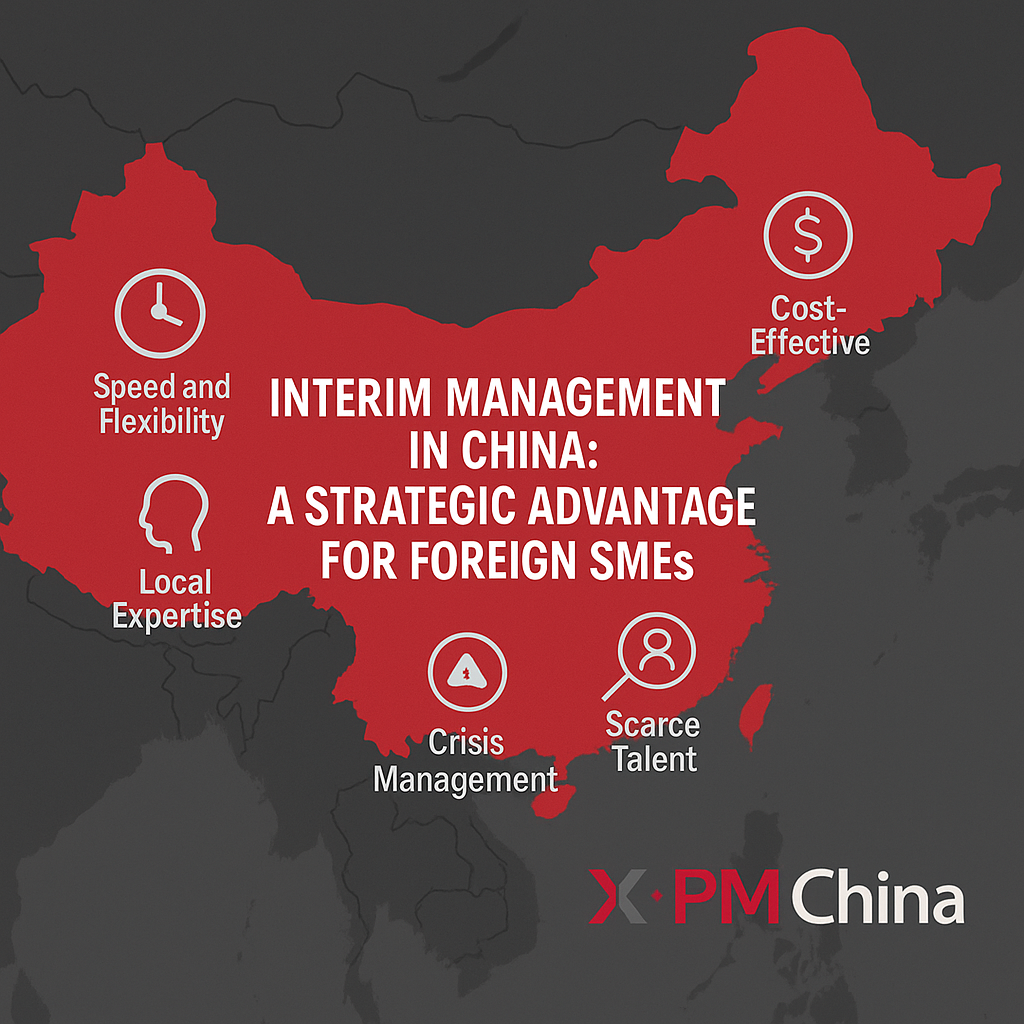
An experienced interim manager can stabilize and lead operations within two to three weeks, while the search for a permanent hire runs in parallel at the right pace.
This is not a stopgap. Done well, it is the opposite of reactive. An interim GM with China experience can hold relationships, make decisions, maintain team confidence, and crucially provide a clear-eyed handover when the permanent hire arrives.
A practical checklist: what to do in the first 72 hours
- Secure the legal position: Confirm who holds legal representative status in your China entity. This role carries personal liability and cannot be left unclear, even temporarily.
- Communicate to the team carefully: Uncertainty breeds rumour. A clear, calm message from HQ within 48 hours matters more than people expect.
- Identify the three most time-sensitive priorities: What cannot wait six months? Name the three most critical items.
- Brief your key external relationships: Reach out personally to top customers, distributors, and key partners.
- Assess interim options in parallel: Run this alongside your permanent search to reduce risk and maintain continuity.
- Set a 90-day stabilization target: Define what “steady state” looks like and give a clear mandate.
The question worth asking before you need to
Most China GM departures are not truly sudden. There were signals. The companies that navigate these transitions best are not the ones that react fastest. They are the ones that asked earlier: what is our Plan B?
Answering these questions before a Tuesday morning email is the difference between a managed transition and a reactive one.
Do you have a Plan B for your China leadership? We'd be interested to hear how foreign companies are thinking about leadership resilience in China right now. Welcome to reach out directly.
X-PM China has been placing interim managers in China for over 20 years. We work with foreign companies navigating leadership transitions, restructuring, and operational change across the country.